
Lunch & Learn |
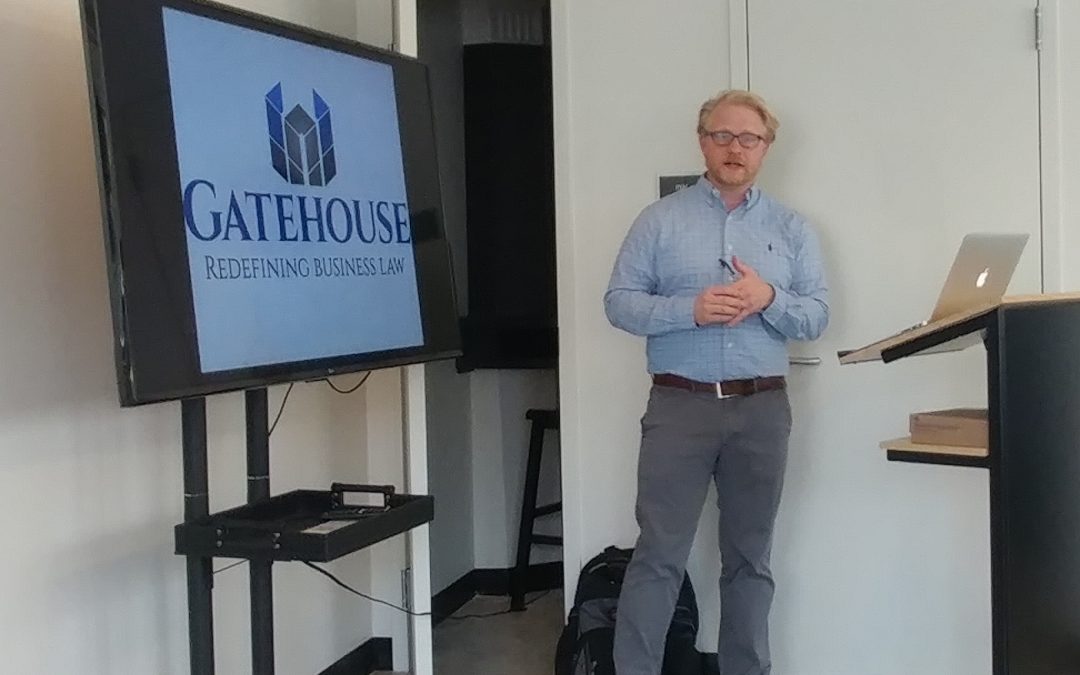
Josh Andrew with Gatehouse Law returned to Forge with a topic that is near and dear to all Entrepreneurs and Small Business owners – or at least it should be! What do you need to know about your business’s trademark? You have legally registered your business, isn’t that enough? Let’s dig a little deeper…

Step 1: Understanding Trademarks
What is a Trademark?
A trademark is a word, phrase or graphic symbol used to show the source of goods or products… or service!
Think of the most notable trademarks: Nike Swoosh, McDonald’s Golden Arches, UPS Brown Box (example of a service)
So, what is the difference between a Trademark and copyright? If you hired a designer to create your logo and they have a copyright for that image, do they own the trademark?
The short answer is no! The copyright protects the artwork or words. The trademark protects the business. So even if your logo has a copyright that you do not own, the trademark is yours!
Step 2: Protecting Trademarks
1. Your Trademark Cannot be “Merely Descriptive”
A merely descriptive mark is one that immediately conveys knowledge of a quality, feature, function or characteristic of an applicant’s goods or services. For example if a dry cleaners named their business “The Dry Cleaners,” they could not lay claim to that name being Trademarked. Anyone could use the same name because it is merely descriptive of the business that it represents.
2. Your Trademark Must have Distinction
It must be:
- Fanciful
- Arbitrary
- Suggestive
All three of these qualities can be legally protected.
3. Protecting Trademarks before you launch. This step is particularly important for those building a business, and not yet in operation. There are three ways to protect your business before you launch.
- Non-disclosure Act. Any time you enter into conversation with someone about your business, have them sign a non-disclosure act regarding the business knowledge shared during the meeting.
- File “Intent to Use.” This is a more costly option and only lasts six months. If you are not in business at the end of six months, but still want to protect the business, there must be another filing.
- Action. Do something with your mark. Setting up a website that collects email addresses is the simplest way to begin acting as a business before you are ready to launch.
Enforcing Trademarks
While ultimately your business needs to have the trademark legally protected, there are a few things that can protect the trademark while the business is growing.
1. Common Law Mark: Trademarks are protected in the immediate area that the business is operating. However this does not prevent your trademark in another part of the country from being used legally.
2. Business Name Registration
3. Notice – By using the trademark, your business trademark is protected (only in the area of operation)
4. Cease and Desist letters. It may seem like an extreme option. But it is the responsibility of the owner to protect the trademark immediately, otherwise the trademark is ineffective.
Thank you Gatehouse Law for teaching us all things Trademarks! We are thankful for firms like Gatehouse Law who serve entrepreneurs and Small Business owners teaching us the things we really need to be thinking about while building our business!
Lunch & Learn |
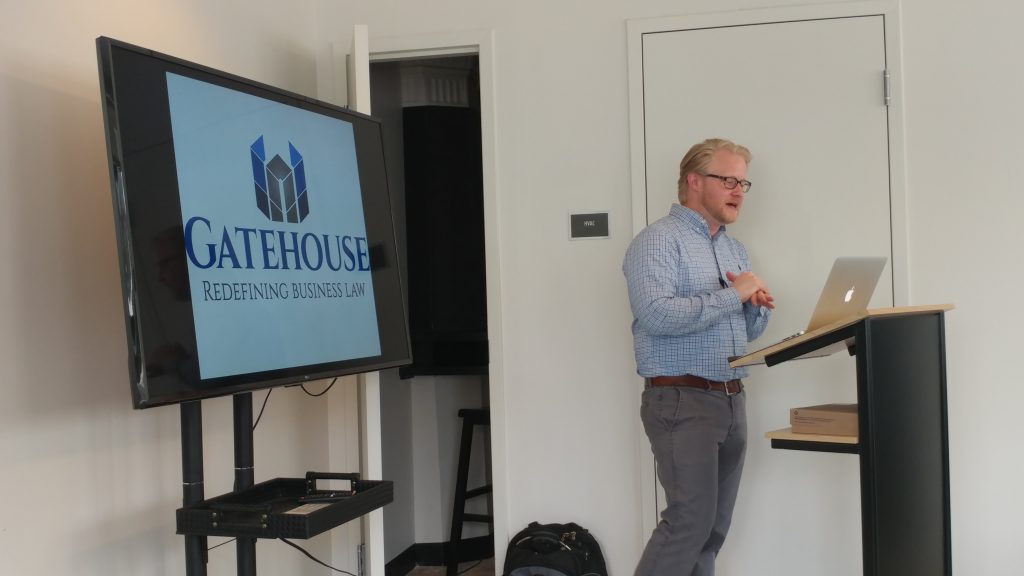
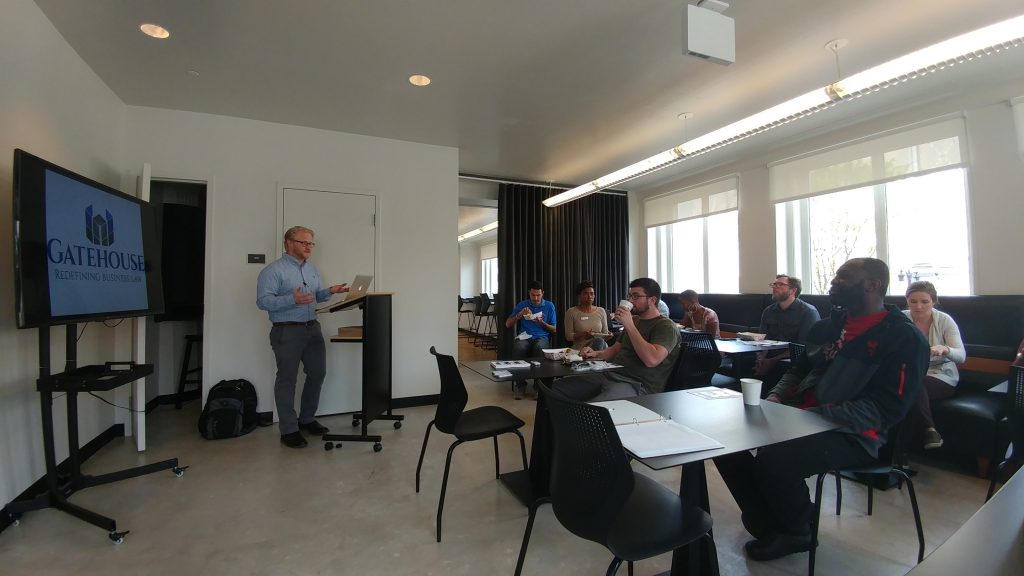
Josh Andrews of Gatehouse Law returned to Forge to teach his third Lunch & Learn focusing on the relationship between small business and legal. This time he focused on contracts and how we can enforce them- even if they aren’t signed!
Let’s start with the basics. What exactly is a contract?
A contract is how we define business- even if we don’t realize it! It’s an agreement between two parties where the obligations are enforceable by law. Don’t forget: oral contracts are real.
4 Elements of a Contract:
- Offer
- Acceptance
- Meeting of the Minds
- Consideration
A contract does not have to be in writing. Repeat: it does not have to be in writing!
There must be competence of the parties– this means the person cannot be in a coma and they also can’t be a child. They must be legally able to enter into a contract and capable of understanding the contract.
Also there must be legal purpose- you obviously can’t enter into a contract to do an illegal thing.
Main idea: if you have an agreement with another party that lasts for more than a fleeting moment in time, you should put your terms in writing!
The things that continue after the point of sale are where your liabilities lie. Contracts are there to protect you!
Contracts can do a few things:
- Limit the liability of your business
- Protect your business for growth
- Give your business the appearance of “having it together”
- Make your business look bigger than it actually is
Make sure your payment terms are crystal clear! “If you don’t pay me, I’ll charge you interest or late fees…and chase you down for collection fees.”
Another main idea: People expect legal. Legal should protect your business for growth, not hinder your business from it.
Acceptance of a contract doesn’t necessarily require a signature! No signature, no problem. You let your customer know how they accept the contract. It may be clicking a box on a website, downloading a PDF, paying for a product, etc. Just make sure you track it! Always track the action that you told the customer is the “acceptance” for your business.
One last thing: Your customer’s numbness to online contracts is not a license to be unfair. We’ve all ‘accepted’ the iTunes terms (or something similar) without reading it all! This doesn’t give you the right to be unfair to your customers.
Gatehouse Law helps small businesses. Check them out!
Lunch & Learn |
We all know what a sales funnel is but we don’t always know how to best implement it. Will Yarbrough of Fleetio came to Forge to teach us more about structuring your specific sales funnel and the model that Fleetio has found success with. We will hit the high points for you- be sure to check out the YouTube video of his presentation too!
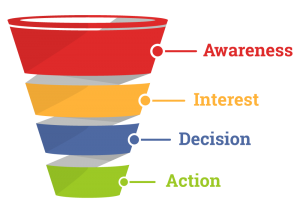
A sales funnel is just a road map- where ultimately money makes it into your bank account. The road map has to be unique to your business!
Big concept: your funnel is your growth strategy
There are 3 Funnels to Rule Them All:
Marketing Funnel (this is one-to-many communication)
- Education
- Brand awareness
- Lead nurturing
- Re-engagement
Lead Funnel (also one-to-many communication, familiarity with who you are)
- Suspect/prospect
- Levels of qualification
- Post sale (helps you get additional customers)
Opportunity Funnel (one-to-one communication)
- Qualification
- Discovery
- Product
- Pricing
- Commitment
Big concept: your funnel is your key to time management
(Time is your most infinite resource!)
In the ‘awareness and consideration’ phase you focus on activities like building brand awareness and domain expertise such as blogging, videos and social media. In the ‘decision and commitment’ phase you focus on other activities like building value and bolstering your company’s credibility through webinars, case studies and business intelligence.
Remember: What gets measured gets done. If you aren’t measuring and tracking, it’ll be hard to understand what you need to do differently. Ask yourself: Where are the leaks? Where are these people coming from? (If leads are coming from social media, focus on continuing your social media and making it better!) Who should we be talking to? What’s scalable? What’s working? What’s not working? What can we tweak?
Big concept: your funnel is your fortune
Typically it takes 18 touches to reach a buyer! You must align your process with your specific customer. Continue to motivate the behaviors that are going to lead to the results you want.
What ideas you should take away:
- “No” doesn’t mean “never”- be persistent!
- Follow up and follow through (if you don’t, they’ll assume this will be their experience as a customer too)
- 50% of sales people never follow up- don’t be that person!
- Figure out your TAM (Total Addressable Market) and break it into niche pockets to focus on!
Lunch & Learn |
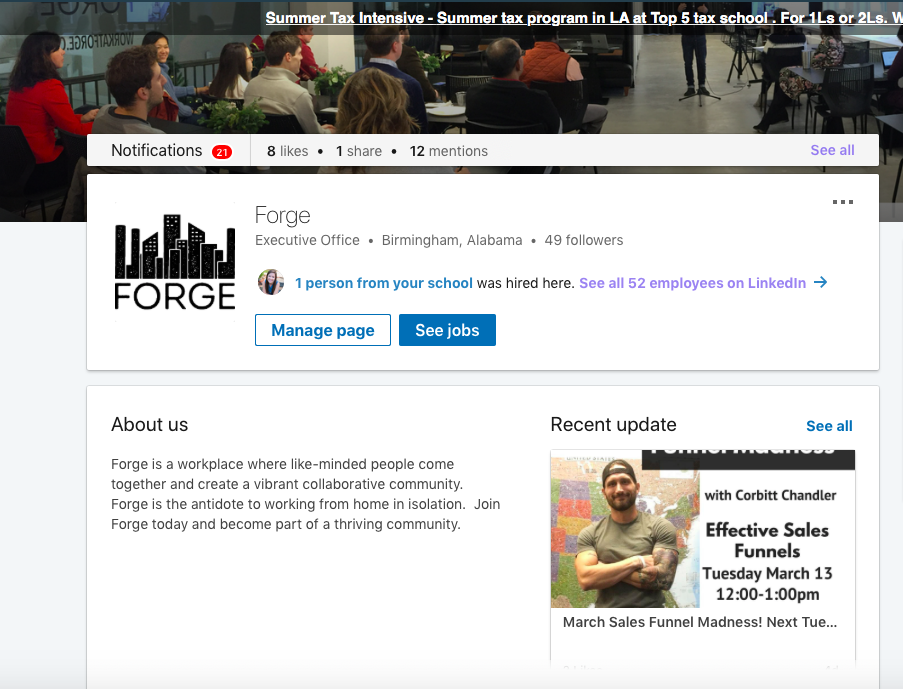
Corbitt Chandler of Apex Current taught our first session of March Sales Funnel Madness at Forge! Apex Current focuses on performance-driven Facebook ads so Corbitt is certainly knowledgeable about how to establish an effective sales funnel for different types of companies.

Check out our PDF that summarizes Corbitt’s Lunch & Learn. Complete with information on how to structure your landing page, the anatomy of a sales funnel, the importance of retargeting your audience and a link to Corbitt’s personal ROI Calculator.

Lunch & Learn |
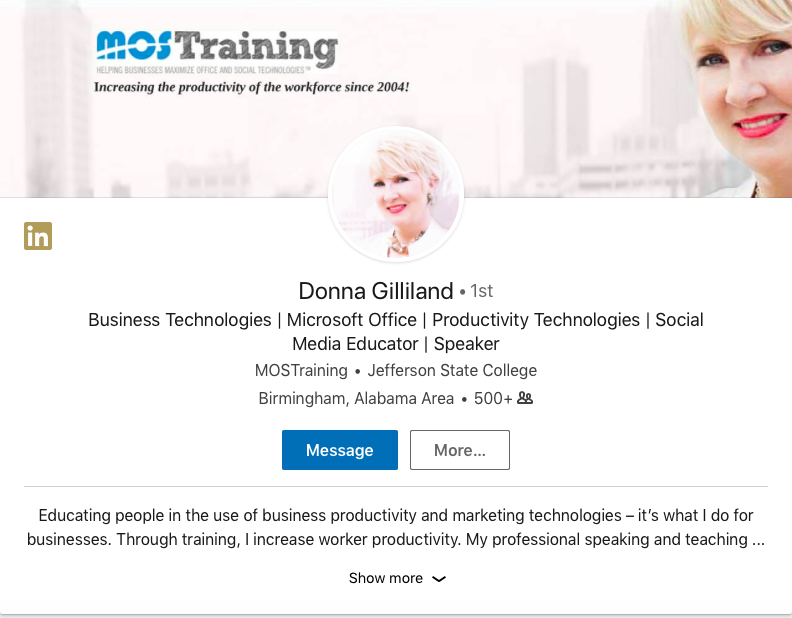
Do you ever feel confused by LinkedIn? Do you wonder if you’re utilizing LinkedIn in the best way possible? Donna Gilliland, Founder of MOSTraining Inc. recently taught us the basics of how to best use LinkedIn.

LinkedIn has over 500 million users! It truly is a powerful tool you can use to help grow your business and brand. Entrepreneurs especially tend to engage heavily on LinkedIn. Donna gave us a few steps for starting a LinkedIn profile (or just coming to finally try out LinkedIn):
Know your goals for being on LinkedIn.
You should really sit down and write our your goals! And create your LinkedIn profile specifically to meet those goals. Start by gathering all of your information: job history, education, skills, certifications, articles, memberships, etc.
Focus on choosing the right background image, profile picture and headliner. Your profile is the first thing people see when they search your name!
Recommend others and build up your own recommendations.
But never accept a recommendation from someone who knows nothing about your work! Also don’t recommend someone who you haven’t worked directly with. When someone recommends you, do the same for them!
Make sure you are findable in LinkedIn Advanced Searches.
In order for people you find you, you must fill out your profile in detail! Use keywords strategically- don’t be guilty of keyword stuffing! Also use conventional job titles- don’t use ‘cute titles.”
Profile tips: you must have a profile picture, add your current position to your profile, add at least 5 skills to your profile and include your city!
Join LinkedIn Groups.
Choose groups based on your industry and interests! Make sure you contribute to those groups- be engaging and helpful! Showcase your expertise and network with industry leaders. Just remember that groups appear on your profile!
Continually add status updates!
LinkedIn Publisher is a blogging tool that can be utilized through your profile. This is a blog within your profile that can showcase your expertise and you can build your own following! Your content becomes part of your profile. Status Updates can help you gain visibility, share information, attract new clients, etc.
Follow LinkedIn Company Pages.
These are great sources of information! You can stay on top of what your competitors are doing too. Be sure to follow your customers’ pages and also your vendors’ pages too.
Thank you Donna for all of this valuable information! I think we all have a checklist of things we can do to improve each of our LinkedIn profiles. Click below to download Donna’s PDF from this Lunch & Learn event. Join us at Forge for future events by checking out our Facebook page!